| |
![]() |
|
||||||||
| |
|
|
|
|
|
|
|
|
|
|
| |
|
|
|
|||||||
Position
Graphic in
desired position on smooth clean wax free surface. Tape if
neccesary
Squeegee out
from the
center of the graphic towards the outside. Making sure not to trap any
air.

Remove the
mask and
you're done. Multi-Color jobs are already together.
Recommended Application Instructions |
| All surfaces are contaminated to some degree. To ensure good adhesion to any vehicle surface it is critical that you follow these recommended procedures in decontaminating and preparing the surface prior to any vinyl product installation. Note: A clean, lint free towel or cloth must be used between each of the cleaning steps. Cleaning Procedures:
|
Step by Step Instructions |
| Tools
required: masking tape, scissors,
squeegee,
lint-free cloth, ruler.
Application temperature should be above 50° F (13° C). If extremely cold, move to an enclosed area and allow the surface temperature to warm. If extremely hot, move to a shaded area. Please refer to application instructions for specific temperature recommendations. |
![]() |
| Step
1 Clean the surface with Lendex Cleaner or a few drops of grease-cutting liquid detergent in water (do not use a petroleum base cleaner). Rinse clean with fresh water then dry with a lint-free cloth. Wiping surface with alcohol will also help remove any contamination and enhance the adhesion process. Please refer to application instructions for additional cleaning procedures. |
| Step
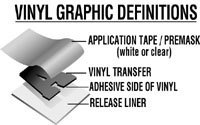
2 Put a piece of masking tape on each end of your vinyl transfer in the area where you plan to apply it and anchor each end to the application surface with masking tape. |
| Step
3 Estimate the center of your vinyl transfer and place two vertical lengths of masking tape to secure the vinyl transfer and create a center hinge as shown in the illustration. This step allows you to apply half of the vinyl transfer at a time. |
| Step
4 Remove the masking tape anchor from one end of your vinyl transfer and SLOWLY peel the release liner away towards the center masking hinge. Be careful not to touch the adhesive side of the vinyl transfer. Use scissors to cut away the excess release liner and discard. |
| Step
5 Hold your vinyl transfer by the application tape, careful not to touch the vinyl adhesive to the application surface until you are ready to squeegee. Beginning at the center hinge, make easy overlapping, pushing strokes with your squeegee. Remove the center hinge tape and slowly peel the remaining release liner away. Squeegee the other half of the vinyl transfer, working from the center to the edges. |
| Step
6 To remove the application tape, peel SLOWLY at a sharp (180°) angle. If the vinyl appears to be lifting, gently push the application tape in the opposite direction from which you were pulling and resqueegee that area. If after removing the application tape, air bubbles are apparent, puncture the vinyl with a pin or needle (DO NOT USE a knife or razor blade) and squeegee out the air towards the puncture. |
| Wet Application Method: Spraying Rapic-Tac onto your application surface will delay the adhesive activation between the bonding surface and vinyl transfer, resulting in a bubble-free, wrinkle-free application. CAUTION: Wet application may delay the immediate removal of the application tape. A waiting period of up to 30 minutes may be necessary. |
| Due to an increased usage of silicone based additives in automotive paint that traditionally contained only solvents or oil derivatives, the pressure-sensitive graphics industry is facing adhesion problems. The result of these changes is the need for increased awareness towards cleaning and surface preparation methods. To reduce the amount of solvents in some of the newer "heavy solids" paint and clearcoat products, silicone-based additives are used as flow agents. As the solvents evaporate during the curing process, silicone particles migrate to the surface, leaving a silicone residue. In fiberglass manufacturing, mold release agents may also leave a silicone residue. Traditional surface preparation for graphics application has consisted of chemical washing. Most cleaners contain a hydroxyl compound (acetone, alcohol) or a petroleum base (kerosene, zylene) solvent. These solvents work by dissolving oil-based impurities that are on the surface. Silicone, however, does not dissolve. Removal of siliconates occurs through emulsification (suspension of small globules within the liquid, like oil in water). Soap and water will generally outperform solvent for silicone emulsification. However, an extra wash process costs applicator time and it may not always be necessary. Each application is
unique.
We need to be aware that the substrates and chemicals are evolving, and
must compensate by adjusting our application processes. |